


Key Insights
- Current Ethereum news focuses on the upcoming activation of Glamsterdam on the Hoodi testnet, scheduled for October 26 at 17:42:48 UTC.
- The upgrade introduces block-level access lists alongside proposer-builder separation, while the gas limit on Hoodi will increase to 200 million.
- On October 20, Ethereum changed hands near $2,384, with an analyst pointing to the $2,150–$2,200 range as a potential downside objective.
Recent Ethereum news highlights the Glamsterdam network upgrade as development teams get ready for another significant testnet rollout. The Ethereum Foundation has verified that the Hoodi testnet will implement the upgrade on October 26, following the Sepolia activation on October 6.
This announcement arrives while the price of Ethereum remains under downward pressure, changing hands around $2,384 on October 20. Technical observers continue to track lower support levels because ETH has struggled to maintain its recent recovery momentum.
Glamsterdam is designed to enhance Ethereum’s transaction processing and block creation capabilities. However, this forthcoming activation applies strictly to the Hoodi testnet, and a mainnet deployment date has not yet been established.
Ethereum News Confirms October 26 for Glamsterdam Upgrade on Hoodi Testnet
The Ethereum Foundation has formally slated Glamsterdam for the Hoodi testnet on October 26, 2026, at 17:42:48 UTC. Hoodi represents the second public testnet to execute this fork, following Sepolia.
Successful runs on both environments typically pave the way for developers to select a mainnet launch date, although no official schedule has been shared thus far.
Glamsterdam integrates two distinct modifications: Amsterdam, which addresses the execution layer, and Gloas, which targets the consensus layer.
The overarching objective is to enable Ethereum’s base layer to execute transactions with greater efficiency without compromising decentralization or security.
Gas limit adjustments are drawing substantial attention across Ethereum news reports. Upon activation, Hoodi will elevate this limit to 200 million.
How Glamsterdam’s ePBS and Block-Level Access Lists Could Improve Ethereum Throughput
The flagship feature is enshrined proposer-builder separation (ePBS), outlined in EIP-7732. Theoretically, this mechanism lessens dependence on third-party trusted relays and provides validators with extra time to review execution payloads.
The second major component involves block-level access lists, specified in EIP-7928. Every individual block will incorporate a mandatory list of the storage slots and accounts it interacts with, accompanied by the resulting state alterations.
Equipped with this list, Ethereum clients can identify inter-dependent transactions and execute state-root tasks, validation, and disk reads in parallel. Such parallel processing serves as the foundation for practical implementation of larger blocks in the future.
Furthermore, Glamsterdam recalibrates gas pricing for calldata, access lists, creating fresh state, and interacting with current state. The intent is to price each action closer to its true cost to the network.
Smart contracts depending on rigid gas assumptions might require modifications. Additionally, the fork introduces a slot-number opcode, ETH transfer logs, and an expanded maximum contract size.
Individuals anticipating that this Ethereum news implies cheaper transaction fees should temper their expectations. Fees will continue to fluctuate based on transaction complexity and overall network demand.
Can Ethereum Hold Above $2,200? Ethereum News Points to Heavy Selling Pressure
Upgrade announcements have dominated the Ethereum news cycle, yet they have provided minimal support to the asset’s valuation. On the 1-hour timeframe, ETH changes hands at approximately $2,384.55 following a sequence of lower highs.
Price action has consolidated sideways within a tight $2,380–$2,400 band, displaying minimal buying demand. Relative Strength Index (RSI) metrics range between 31 and 43, with the most responsive metric approaching oversold conditions.
The Moving Average Convergence Divergence (MACD) histogram registers slightly negative values, giving sellers a minor advantage. Open interest is climbing while price action remains sluggish, indicating new positions are being opened, though market charts alone cannot determine if participants are positioned long or short.
Immediate support rests within the $2,370–$2,380 zone, with a larger swing low situated near $2,318. Looking upward, ETH must clear the $2,400–$2,420 threshold initially, followed by the $2,450–$2,480 resistance band.
Market commentator Ted expressed the general sentiment on X, noting, “Buyers are disappearing, and any small pump is getting sold.”
Ethereum Price Prediction: Could ETH Revisit the $2,150–$2,200 Zone?
Ted anticipates that Ethereum may test the $2,150–$2,200 region prior to mounting a recovery. Measured from current valuations, that movement would represent an additional drawdown of roughly 8% to 10%.
Short-term charting indicators advocate for caution. A breakdown beneath $2,370 would bring $2,350 into focus, paving the way for a retest of $2,318.
Should that primary swing low fail to hold, Ted’s projected target zone comes into play. For market conditions to improve, ETH needs to reclaim levels above $2,420 and decisively break through $2,450. Without these moves, a continuation of sideways consolidation between $2,370 and $2,400 remains the most probable outcome.
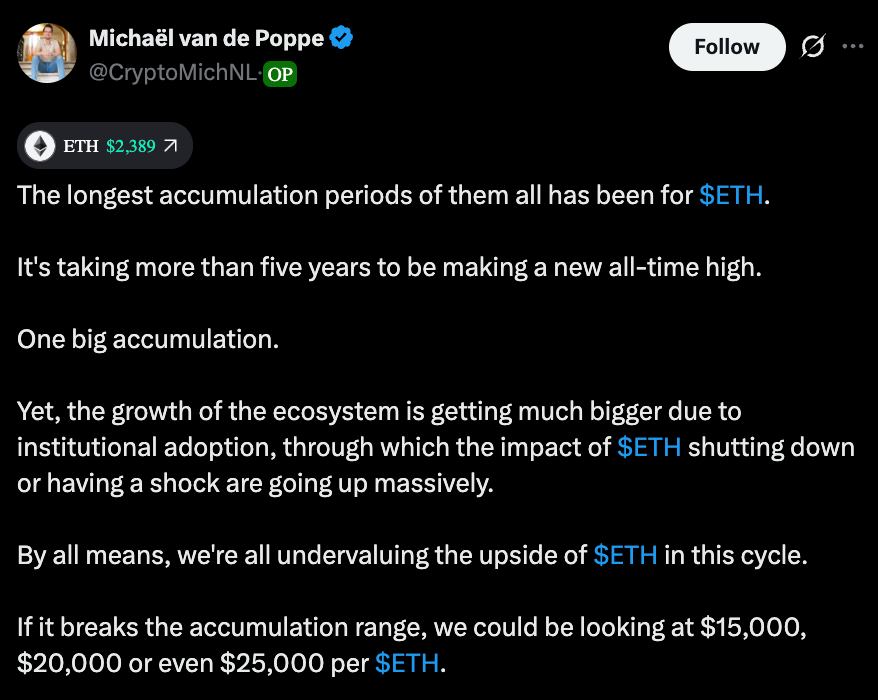
Long-term outlooks maintain a significantly more optimistic perspective. Analyst Michaël van de Poppe characterized ETH’s multi-year trading channel as “one big accumulation,” pointing out that establishing a new all-time high has required upwards of five years.
He maintains that “we’re all undervaluing the upside of $ETH in this cycle” and suggests that a decisive breakout from this range could propel the asset toward “$15,000, $20,000 or even $25,000.”
This week’s updates provide proponents with a compelling technical narrative, even as price charts lean in favor of sellers. Glamsterdam’s deployment on the Hoodi testnet scheduled for October 26 marks the next critical milestone on the calendar, where a seamless testnet execution could draw a mainnet timeline closer.
Frequently Asked Questions
When is the Glamsterdam upgrade scheduled for the Hoodi testnet?
The Ethereum Foundation has scheduled the Glamsterdam upgrade for the Hoodi testnet on October 26 at 17:42:48 UTC.
What are the main features introduced in the Glamsterdam upgrade?
Glamsterdam introduces enshrined proposer-builder separation (ePBS via EIP-7732) and block-level access lists (EIP-7928), alongside gas limit increases and various execution and consensus layer modifications.
What is the price outlook and immediate support for ETH?
ETH traded near $2,384 on October 20 with immediate support between $2,370 and $2,380. Technical analysts warn that failure to hold support could risk a drop to the $2,150–$2,200 downside target zone.